Am Dienstag000006, 06.01.2026 um 00:47 schrieb Thomas 'PointedEars' Lahn:
Chris M. Thomasson wrote:
On 1/5/2026 3:09 PM, Chris M. Thomasson wrote:
Say to explain a 3d point in time we need (x, y, z, t), t for time.
For a 4d point we need (x, y, z, w, t), t for time.
t is in every dimension?
For a 2d (x, y, t)
For a 1d (x, t)
Why not keep time in the dimension, [...]
Again, this wording does not make sense. Time, here represented by the
coordinate t, *is* a dimension then *implicitly*.
The word 'dimension' has different meanings, hence it is necessary to
write, which meaning was meant.
If we refer to space, the 'usual' space has three dimensions of the type 'length', which are orthogonal towards each other.
This wouldn't allow an additional orthogonal dimension of space for time.
So, we need a different meaning for 'dimension' and a different 'space'.
If we add t to the 'x,y,z-space' we end up in what is called spacetime.
But I would suggest a different approach and use complex numbers and
assume, that time is imaginary and the dimensions of space real.
An even better approach would be to use a construct called
'biquaternions' and assume, that the 'real space' has actually such features, as if it was a quaternion-field, where points have the
features of bi-quaternions.
This would allow three imaginary axes of time and three real axes of
space, plus two additional 'dimensions' for scalars and pseudo-scalars.
I have written a kind of book about this idea some years ago, which can
be found here:
https://docs.google.com/presentation/ d/1Ur3_giuk2l439fxUa8QHX4wTDxBEaM6lOlgVUa0cFU4/edit?usp=sharing
On 1/6/2026 11:47 PM, Thomas Heger wrote:
Am Dienstag000006, 06.01.2026 um 00:47 schrieb Thomas 'PointedEars' Lahn: >>> Chris M. Thomasson wrote:
On 1/5/2026 3:09 PM, Chris M. Thomasson wrote:
Say to explain a 3d point in time we need (x, y, z, t), t for time.
For a 4d point we need (x, y, z, w, t), t for time.
t is in every dimension?
For a 2d (x, y, t)
For a 1d (x, t)
Why not keep time in the dimension, [...]
Again, this wording does not make sense. Time, here represented by the >>> coordinate t, *is* a dimension then *implicitly*.
The word 'dimension' has different meanings, hence it is necessary to
write, which meaning was meant.
If we refer to space, the 'usual' space has three dimensions of the
type 'length', which are orthogonal towards each other.
This wouldn't allow an additional orthogonal dimension of space for time.
So, we need a different meaning for 'dimension' and a different 'space'.
If we add t to the 'x,y,z-space' we end up in what is called spacetime.
But I would suggest a different approach and use complex numbers and
assume, that time is imaginary and the dimensions of space real.
An even better approach would be to use a construct called
'biquaternions' and assume, that the 'real space' has actually such
features, as if it was a quaternion-field, where points have the
features of bi-quaternions.
This would allow three imaginary axes of time and three real axes of
space, plus two additional 'dimensions' for scalars and pseudo-scalars.
When I would add a t to a vector, say (x, y, z, t), yes its confusing. I would only use the (x, y, z) parts for the vector math, ect. The t was a point in time for that (x, y, z) vector. So, say:
(-.5, .1, -.16, 0)
The t aspect is at say, a stop watch started from zero. It ticks. Now,
the same point can be:
(-.5, .1, -.16, 0.0000001)
well, the granularity of the t aside for a moment. However, we now have
the same point in a different time.
As time ticks by we have a shit load of vectors at the same point, but
with different non-zero t components. We can sort them based on t after
some iterations... ect. Its fun to do, ponder on. So a single point that stays the same can have different t's. However, it does not mean that t
is a 4d space. No, its a 3d space with t. For a 4d space (x, y, z, w,
t), on and on. But it is confusing.
Actually, I don't know where to plot a 4d point with a non-zero w
component. One time I said just plot the 3d components (x, y, z), and
use w as a color spectrum that is unique. So, I can say here is a 4d
point and its a certain color. This tells me that the point is off axis
from the pure 3d world, aka non-zero w.
I have written a kind of book about this idea some years ago, which
can be found here:
https://docs.google.com/presentation/
d/1Ur3_giuk2l439fxUa8QHX4wTDxBEaM6lOlgVUa0cFU4/edit?usp=sharing
Hummm... Need to read that when I get some more time. Thanks!
Am Mittwoch000007, 07.01.2026 um 20:46 schrieb Chris M. Thomasson:
On 1/6/2026 11:47 PM, Thomas Heger wrote:
Am Dienstag000006, 06.01.2026 um 00:47 schrieb Thomas 'PointedEars'
Lahn:
Chris M. Thomasson wrote:
On 1/5/2026 3:09 PM, Chris M. Thomasson wrote:
Say to explain a 3d point in time we need (x, y, z, t), t for time. >>>>>>
For a 4d point we need (x, y, z, w, t), t for time.
t is in every dimension?
For a 2d (x, y, t)
For a 1d (x, t)
Why not keep time in the dimension, [...]
Again, this wording does not make sense. Time, here represented by the >>>> coordinate t, *is* a dimension then *implicitly*.
The word 'dimension' has different meanings, hence it is necessary to
write, which meaning was meant.
If we refer to space, the 'usual' space has three dimensions of the
type 'length', which are orthogonal towards each other.
This wouldn't allow an additional orthogonal dimension of space for
time.
So, we need a different meaning for 'dimension' and a different 'space'. >>>
If we add t to the 'x,y,z-space' we end up in what is called spacetime.
But I would suggest a different approach and use complex numbers and
assume, that time is imaginary and the dimensions of space real.
An even better approach would be to use a construct called
'biquaternions' and assume, that the 'real space' has actually such
features, as if it was a quaternion-field, where points have the
features of bi-quaternions.
This would allow three imaginary axes of time and three real axes of
space, plus two additional 'dimensions' for scalars and pseudo-scalars.
When I would add a t to a vector, say (x, y, z, t), yes its confusing.
I would only use the (x, y, z) parts for the vector math, ect. The t
was a point in time for that (x, y, z) vector. So, say:
(-.5, .1, -.16, 0)
The t aspect is at say, a stop watch started from zero. It ticks. Now,
the same point can be:
(-.5, .1, -.16, 0.0000001)
well, the granularity of the t aside for a moment. However, we now
have the same point in a different time.
As time ticks by we have a shit load of vectors at the same point, but
with different non-zero t components. We can sort them based on t
after some iterations... ect. Its fun to do, ponder on. So a single
point that stays the same can have different t's. However, it does not
mean that t is a 4d space. No, its a 3d space with t. For a 4d space
(x, y, z, w, t), on and on. But it is confusing.
Actually, I don't know where to plot a 4d point with a non-zero w
component. One time I said just plot the 3d components (x, y, z), and
use w as a color spectrum that is unique. So, I can say here is a 4d
point and its a certain color. This tells me that the point is off
axis from the pure 3d world, aka non-zero w.
Look at this:
https://www.maeckes.nl/Tekeningen/Complexe%20vlak%20.png
(from here: https://www.maeckes.nl/Arganddiagram%20GB.html )
This is a so called 'Argand diagram' or a 'complex plane'.
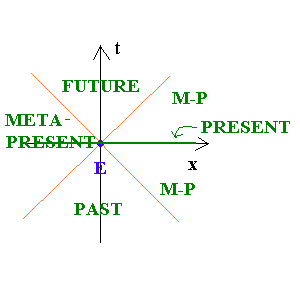
And now compare it to this diagram:
https://www.math.brown.edu/tbanchof/STG/ma8/papers/dmargalit/project/pastpres.gif
This stems from here: https://www.math.brown.edu/tbanchof/STG/ma8/papers/dmargalit/project/minkowsk.html
and is called 'Minkowski diagram'.
You'll certainly see some similarities.
But Minkowski diagrams are as flat as Argand diagrams, hence we need to
'pump them up' to 3D.
That ain't actually possible and we need four dimensions (at least) of
which at least one is imaginary.
This would end up in the realm of quaternions.
Unfortunately Hamilton's quaternions do not really fit to the real
world, hence we need something slightly different.
My suggestion was: use 'biquaternions' (aka 'complex four vectors')
I have written a kind of book about this idea some years ago, which
can be found here:
https://docs.google.com/presentation/
d/1Ur3_giuk2l439fxUa8QHX4wTDxBEaM6lOlgVUa0cFU4/edit?usp=sharing
Hummm... Need to read that when I get some more time. Thanks!
Well, that 'book' ain't perfect, because it was the first thing I have written about physics. It's also written in English, which is a second language for me (I from Germany).
I'm also not a physicist and that 'book' was the result of a hobby.
But still I think, the concept is quite good.
TH
The idea that everything physics is always parameterized
by time or 't' is often formalized "the Lagrangian",
sort of like "the Machian" is a usual notion of far-field.
[pseudo-scientific word salad]
Ross Finlayson wrote:
The idea that everything physics is always parameterized
by time or 't' is often formalized "the Lagrangian",
No, the parametrization by time is a concept in Lagrangian _mechanics_ which is based on the _principle of stationary ("least") action_. The action is defined as
S[x(t)] = ∫ dt L[x(t), dx(t)/dt, t],
where x may be a vector (field), and L is the Lagrangian (function).
[Both S and L are *functionals*: they depend on a function, x(t);
hence the customary notation with rectangular brackets.]
In special relativity, one finds from the Minkowski metric
ds^2 = c^2 dτ² = c^2 dt^2 - dx^2 - dy^2 - dz^2
= c^2 dt^2 [1 - (dx/dt)^2 - (dy/dt)^2 - (dz/dt)^2]
= c^2 dt^2 (1 - V^2/c^2)
that
S[x] = -m c ∫ ds = -m c ∫ dt c √(1 - V^2/c^2)
= ∫ dt [-m c^2 √(1 - V^2/c^2)],
where the prefactor -m c is introduced so as to produce a quantity with dimensions of action (energy × time, cf. ℎ and ℏ) and the correct canonical
momentum [*], and in the integrand one with dimensions of energy; so the relativistic non-interacting Lagrangian is
L = -m c^2 √(1 - V^2/c^2) = -m c^2 √[1 - (dX/dt)^2/c^2].
It turns out that this leads to the correct energy--momentum relation,
as I pointed out earlier.
[*] For example, the canonical 3-momentum is, from the Euler--Lagrange
equations
0 = d/dt ∂L/∂(dX/dt) - ∂L/∂X = d/dt ∂L/∂V - ∂L/∂X = d/dt ∂L/∂V
P = ∂L/∂V
= -m c^2 ∂/∂V √(1 - V^2/c^2)
= -m c^2/[2 √(1 - V^2/c^2)] ∂/∂V (1 - V^2/c^2)
= -m c^2/[2 √(1 - V^2/c^2)] (-2 V/c^2)
= m V/√(1 - v^2/c^2)
= γ(v) m V.
[It is interesting to note that this way the relativistic/exact 3-momentum
for a massive particle can be derived purely from the Minkowski metric,
without a Lorentz transformation (but the Minkowski metric is Lorentz-
invariant, somewhat by design [I showed before that you do not even
need to assume Lorentz invariance to derive it, just a constant speed
with which information propagates in space)].
Since from the above follows that ds = c dτ, one can also write
S[x(τ)] = -m c ∫ dτ c = -m c^2 ∫ dτ.
The physical paths of free motion, which (one can prove) are spacetime geodesics, are those where the action S[x(t)] is minimal (stationary in general). From the form above one can see that those are the trajectories W along which the elapsed proper time ∆τ = ∫_W dτ is maximal, which is another
way of describing "time dilation" when there is relative motion, and finally explaining the "twin paradox" as nothing more than a consequence of
different elapsed proper times along different worldlines.
One can also see here that mass arises naturally from assuming the principle of stationary action.
sort of like "the Machian" is a usual notion of far-field.
No, nonsense.
[pseudo-scientific word salad]
You are a hopeless case.
Am Mittwoch000007, 07.01.2026 um 20:46 schrieb Chris M. Thomasson:
On 1/6/2026 11:47 PM, Thomas Heger wrote:
Am Dienstag000006, 06.01.2026 um 00:47 schrieb Thomas 'PointedEars'
Lahn:
Chris M. Thomasson wrote:
On 1/5/2026 3:09 PM, Chris M. Thomasson wrote:
Say to explain a 3d point in time we need (x, y, z, t), t for time. >>>>>>
For a 4d point we need (x, y, z, w, t), t for time.
t is in every dimension?
For a 2d (x, y, t)
For a 1d (x, t)
Why not keep time in the dimension, [...]
Again, this wording does not make sense. Time, here represented by the >>>> coordinate t, *is* a dimension then *implicitly*.
The word 'dimension' has different meanings, hence it is necessary to
write, which meaning was meant.
If we refer to space, the 'usual' space has three dimensions of the
type 'length', which are orthogonal towards each other.
This wouldn't allow an additional orthogonal dimension of space for
time.
So, we need a different meaning for 'dimension' and a different 'space'. >>>
If we add t to the 'x,y,z-space' we end up in what is called spacetime.
But I would suggest a different approach and use complex numbers and
assume, that time is imaginary and the dimensions of space real.
An even better approach would be to use a construct called
'biquaternions' and assume, that the 'real space' has actually such
features, as if it was a quaternion-field, where points have the
features of bi-quaternions.
This would allow three imaginary axes of time and three real axes of
space, plus two additional 'dimensions' for scalars and pseudo-scalars.
When I would add a t to a vector, say (x, y, z, t), yes its confusing.
I would only use the (x, y, z) parts for the vector math, ect. The t
was a point in time for that (x, y, z) vector. So, say:
(-.5, .1, -.16, 0)
The t aspect is at say, a stop watch started from zero. It ticks. Now,
the same point can be:
(-.5, .1, -.16, 0.0000001)
well, the granularity of the t aside for a moment. However, we now
have the same point in a different time.
As time ticks by we have a shit load of vectors at the same point, but
with different non-zero t components. We can sort them based on t
after some iterations... ect. Its fun to do, ponder on. So a single
point that stays the same can have different t's. However, it does not
mean that t is a 4d space. No, its a 3d space with t. For a 4d space
(x, y, z, w, t), on and on. But it is confusing.
Actually, I don't know where to plot a 4d point with a non-zero w
component. One time I said just plot the 3d components (x, y, z), and
use w as a color spectrum that is unique. So, I can say here is a 4d
point and its a certain color. This tells me that the point is off
axis from the pure 3d world, aka non-zero w.
Look at this:
https://www.maeckes.nl/Tekeningen/Complexe%20vlak%20.png
(from here: https://www.maeckes.nl/Arganddiagram%20GB.html )
This is a so called 'Argand diagram' or a 'complex plane'.
And now compare it to this diagram:
https://www.math.brown.edu/tbanchof/STG/ma8/papers/dmargalit/project/ pastpres.gif
This stems from here: https://www.math.brown.edu/tbanchof/STG/ma8/papers/dmargalit/project/ minkowsk.html
and is called 'Minkowski diagram'.
You'll certainly see some similarities.
But Minkowski diagrams are as flat as Argand diagrams, hence we need to 'pump them up' to 3D.
That ain't actually possible and we need four dimensions (at least) of
which at least one is imaginary.
This would end up in the realm of quaternions.
Unfortunately Hamilton's quaternions do not really fit to the real
world, hence we need something slightly different.
My suggestion was: use 'biquaternions' (aka 'complex four vectors')
I have written a kind of book about this idea some years ago, which
can be found here:
https://docs.google.com/presentation/
d/1Ur3_giuk2l439fxUa8QHX4wTDxBEaM6lOlgVUa0cFU4/edit?usp=sharing
Hummm... Need to read that when I get some more time. Thanks!
Well, that 'book' ain't perfect, because it was the first thing I have written about physics. It's also written in English, which is a second language for me (I from Germany).
I'm also not a physicist and that 'book' was the result of a hobby.
But still I think, the concept is quite good.
On 01/08/2026 05:55 PM, Thomas 'PointedEars' Lahn wrote:
Ross Finlayson wrote:
The idea that everything physics is always parameterized
by time or 't' is often formalized "the Lagrangian",
No, the parametrization by time is a concept in Lagrangian _mechanics_
which
is based on the _principle of stationary ("least") action_. The
action is
defined as
S[x(t)] = ∫ dt L[x(t), dx(t)/dt, t],
where x may be a vector (field), and L is the Lagrangian (function).
[Both S and L are *functionals*: they depend on a function, x(t);
hence the customary notation with rectangular brackets.]
In special relativity, one finds from the Minkowski metric
ds^2 = c^2 dτ² = c^2 dt^2 - dx^2 - dy^2 - dz^2
= c^2 dt^2 [1 - (dx/dt)^2 - (dy/dt)^2 - (dz/dt)^2]
= c^2 dt^2 (1 - V^2/c^2)
that
S[x] = -m c ∫ ds = -m c ∫ dt c √(1 - V^2/c^2)
= ∫ dt [-m c^2 √(1 - V^2/c^2)],
where the prefactor -m c is introduced so as to produce a quantity with
dimensions of action (energy × time, cf. ℎ and ℏ) and the correct
canonical
momentum [*], and in the integrand one with dimensions of energy; so the
relativistic non-interacting Lagrangian is
L = -m c^2 √(1 - V^2/c^2) = -m c^2 √[1 - (dX/dt)^2/c^2].
It turns out that this leads to the correct energy--momentum relation,
as I pointed out earlier.
[*] For example, the canonical 3-momentum is, from the Euler--Lagrange
equations
0 = d/dt ∂L/∂(dX/dt) - ∂L/∂X = d/dt ∂L/∂V - ∂L/∂X = d/dt ∂L/∂V
P = ∂L/∂V
= -m c^2 ∂/∂V √(1 - V^2/c^2)
= -m c^2/[2 √(1 - V^2/c^2)] ∂/∂V (1 - V^2/c^2)
= -m c^2/[2 √(1 - V^2/c^2)] (-2 V/c^2)
= m V/√(1 - v^2/c^2)
= γ(v) m V.
[It is interesting to note that this way the relativistic/exact
3-momentum
for a massive particle can be derived purely from the Minkowski
metric,
without a Lorentz transformation (but the Minkowski metric is
Lorentz-
invariant, somewhat by design [I showed before that you do not even
need to assume Lorentz invariance to derive it, just a constant speed
with which information propagates in space)].
Since from the above follows that ds = c dτ, one can also write
S[x(τ)] = -m c ∫ dτ c = -m c^2 ∫ dτ.
The physical paths of free motion, which (one can prove) are spacetime
geodesics, are those where the action S[x(t)] is minimal (stationary in
general). From the form above one can see that those are the
trajectories W
along which the elapsed proper time ∆τ = ∫_W dτ is maximal, which is >> another
way of describing "time dilation" when there is relative motion, and
finally
explaining the "twin paradox" as nothing more than a consequence of
different elapsed proper times along different worldlines.
One can also see here that mass arises naturally from assuming the
principle
of stationary action.
sort of like "the Machian" is a usual notion of far-field.
No, nonsense.
[pseudo-scientific word salad]
You are a hopeless case.
So, parameterized by time then, like I said,
like Lagrange says.
You mention least action and it's a pretty reasonable
principle, where the theory is sum-of-histories sum-of-potentials least-action least-gradient a continuum mechanics, that
obviously enough it's a field theory.
You know, momentum isn't very much conserved in kinematics.
It sort of adds up for each of the ideal equal/opposite
inelastic interactions, yet any sort of rotation loses it.
Much like "whatever satisfies the _Lorentzian_ is a model
of relativity", there's that "whatever satisfies the
_Lagrangian_ is a model of relativity with a clock hypothesis".
Perhaps you might be familiar with the notion of "implicits",
for example that "x" is "x(t)" and forces are always implicitly
functions of time, t, and so on.
Forces are functions of time, ....
Then, besides that logic demands a temporality else
it's readily demonstrable as false, time the usual
parameter t is an implicit.
Implicits may remind
of "running constants", then for example about notions
like the monomode process, since usually accounts as
after the _Laplacian_, the sum of 2'nd order partials,
the _Lorentzian_, the sum of 2'nd order partials x +- t,
and whether that's zero or off-zero, non-zero.
The differential d and partial-differential little-greek-d
are two different things, your Lagrangian L is already
second-order in d^2 t while velocity V is only first
order, then taking their partials w.r.t. each other,
finds that now what was taken as the root of the square,
gets issues with the nilpotent and nilsquare, about
the off-zero case, helping explain why what falls out
as a linear expression or in simple terms,
ignores part of its own derivation there.
Otherwise it's quite plainly Galilean, one may note.
(Eg, any "unboundedness as infinity".)
Meeting the form, ....
Yeah, it seems quite so that the larger reasoners
very well appreciate the contents of that "T-theory,
A-Theory, theatheory" thread.
Including its logical elements, its mathematical elements,
and otherwise its canonical and novel elements, so relevant.
Then also for physics.
It seems the action S is simply contrived to dump out
the usual definition, as it is, "timeless", and absent
moment, of momentum the linear since Lagrange.
Being that it's just "defined".
"Implicits" is what's involved, since whatever then
results in the derivations cancelling themselves away,
perfectly model Lagrangians, Lorentzians, ..., Laplacians,
a hollow shell.
Chris M. Thomasson wrote:
On 1/5/2026 3:47 PM, Thomas 'PointedEars' Lahn wrote:
Chris M. Thomasson wrote:
On 1/5/2026 3:09 PM, Chris M. Thomasson wrote:
Say to explain a 3d point in time we need (x, y, z, t), t for time.
For a 4d point we need (x, y, z, w, t), t for time.
t is in every dimension?
For a 2d (x, y, t)
For a 1d (x, t)
Why not keep time in the dimension, [...]
Again, this wording does not make sense. Time, here represented by the
coordinate t, *is* a dimension then *implicitly*.
Yeah. Well, fwiw, in my vector field sometimes I would encode the mass
for a point in the vector itself:
*Physically* that does not make a lot of sense, although one could argue
that the mass of a _point-like object_ that is initially _at_ a point of
(3D) space and subsequently perhaps found _at_ different points of that
space (which is what you *actually* mean) is a degree of freedom.
The physics would be better represented computationally by defining a point-like object as an _object_ (using object-oriented programming, or something equivalent like a C-struct) with at least two properties/attributes: its position, given as a vector/array/list, and, separately, its mass.
vec4 = point (x, y, z, m) where m is the pass of the point. It can see
how it can get confusing. When I would plot the points I would take the
vec3 out of it so:
vec3 m0 = point
Which programming language is that?
where m0 equals the (x, y, z) components of point.
That appears to me to be a bad (because confusing, and not self-explaining) choice of variable identifier as well. I would call that variable "coords" (for "coordinates") or "position" instead.
https://www.facebook.com/photo/?fbid=1218640825961580&set=pcb.1218640912628238
(btw can you see the content of the link? thanks. It should be public.)
I can see it fully when I am logged in into Facebook. Otherwise I can see
it only partially as Facebook's "Log in or sign up for Facebook ..." bar covers the bottom of it.
Unfortunately, the photos are slightly blurred so one cannot see the images clearly and cannot scan the QR code.
The images by you for the content of the AMS 2025 Calendar are nicely done. What exactly am I looking at there? (I found <https://gallery.bridgesmathart.org/exhibitions/2024-joint-mathematics-meetings/chris-m-thomasson>)
On 1/6/2026 8:29 AM, Thomas 'PointedEars' Lahn wrote:
Chris M. Thomasson wrote:
On 1/5/2026 3:47 PM, Thomas 'PointedEars' Lahn wrote:
Chris M. Thomasson wrote:
On 1/5/2026 3:09 PM, Chris M. Thomasson wrote:
Say to explain a 3d point in time we need (x, y, z, t), t for time. >>>>>>
For a 4d point we need (x, y, z, w, t), t for time.
t is in every dimension?
For a 2d (x, y, t)
For a 1d (x, t)
Why not keep time in the dimension, [...]
Again, this wording does not make sense. Time, here represented by the >>>> coordinate t, *is* a dimension then *implicitly*.
Yeah. Well, fwiw, in my vector field sometimes I would encode the mass
for a point in the vector itself:
*Physically* that does not make a lot of sense, although one could argue
that the mass of a _point-like object_ that is initially _at_ a point of
(3D) space and subsequently perhaps found _at_ different points of that
space (which is what you *actually* mean) is a degree of freedom.
The physics would be better represented computationally by defining a
point-like object as an _object_ (using object-oriented programming, or
something equivalent like a C-struct) with at least two
properties/attributes: its position, given as a vector/array/list, and,
separately, its mass.
vec4 = point (x, y, z, m) where m is the pass of the point. It can see
how it can get confusing. When I would plot the points I would take the
vec3 out of it so:
vec3 m0 = point
Which programming language is that?
where m0 equals the (x, y, z) components of point.
That appears to me to be a bad (because confusing, and not self-
explaining)
choice of variable identifier as well. I would call that variable
"coords"
(for "coordinates") or "position" instead.
https://www.facebook.com/photo/?
fbid=1218640825961580&set=pcb.1218640912628238
(btw can you see the content of the link? thanks. It should be public.)
I can see it fully when I am logged in into Facebook. Otherwise I can
see
it only partially as Facebook's "Log in or sign up for Facebook ..." bar
covers the bottom of it.
Unfortunately, the photos are slightly blurred so one cannot see the
images
clearly and cannot scan the QR code.
The images by you for the content of the AMS 2025 Calendar are nicely
done.
What exactly am I looking at there? (I found
<https://gallery.bridgesmathart.org/exhibitions/2024-joint-
mathematics-meetings/chris-m-thomasson>)
Fwiw, here is a 3d model that popped out of my vector field code:
(ctHyperField)
https://skfb.ly/pyP9E
I hope your browser can load it up and you can fly around and explore
it. Fwiw, here is another one:
https://skfb.ly/pzTEC
https://skfb.ly/pyXH6
Fwiw, these are pure 3d vectors in the sense that the w components of
every one of them during iteration is zero.
Can you explore them?
You mention least action and it's a pretty reasonable principle,
where the theory is sum-of-histories sum-of-potentials
least-action least-gradient a continuum mechanics, that
obviously enough it's a field theory.
You know, momentum isn't very much conserved in kinematics.
[pseudo-scientific word salad]--
Here, the first term (the one before the minus sign) is the "kinetic
term", and the second one is the "mass term".
You ought to trim your quotations to the relevant minimum.
Ross Finlayson wrote:
You mention least action and it's a pretty reasonable principle,
Yes, it is.
where the theory is sum-of-histories sum-of-potentials
least-action least-gradient a continuum mechanics, that
obviously enough it's a field theory.
No, no and no. That's such a nonsense, it's not even wrong.
You know, momentum isn't very much conserved in kinematics.
It is conserved if no force is acting. Different to Newtonian mechanics, Lagrangian mechanics proves this in a way that does not already presume Newton's Laws of Motion:
The Euler--Lagrange equation for the coordinate x is
d/dt ∂L/∂(dx/dt) - ∂L/∂x = 0.
("t" could be any parameter, but in physics it is usually taken as time.)
∂L/∂(dx/dt) is the *canonical momentum conjugate to x*, a terminology that
stems from that for the Newtonian Lagrangian one finds
∂L/∂(dx/dt) = m v_x = p_x
(see below).
If ∂L/∂x = 0, then trivially
d/dt ∂L/∂(dx/dt) = 0,
i.e. ∂L/∂(dx/dt) is conserved.
The Newtonian Lagrangian is in one dimension
L = T(dx/dt) - U(x) = 1/2 m (dx/dt)^2 - U(x)
where T is the kinetic energy and U is the potential energy. Therefore,
∂L/∂x = -∂U/∂x = F_x.
So
F_x = d/dt p_x,
and if F_x = 0, then
d/dt p_x = 0,
i.e. the x-component of the linear momentum is conserved.
This is obtained analogously for the 3-dimensional Lagrangian (here in Cartesian coordinates)
L = 1/2 m (dX/dt)^2 - U(X)
= 1/2 m [(dx/dt)^2 + (dy/dt)^2 + (dz/dt)^2] - U(x, y, z),
and y and z, so
F = -(∂U/∂x, ∂U/∂y, ∂U/∂z)^T = -∇U = d/dt P
(Newton's Second Law of Motion). So if F = 0, then
d/dt P = 0
(Newton's First Law of Motion), and the linear momentum is conserved.
[pseudo-scientific word salad]
On 01/09/2026 03:13 AM, Thomas 'PointedEars' Lahn wrote:
You ought to trim your quotations to the relevant minimum.
Ross Finlayson wrote:
You mention least action and it's a pretty reasonable principle,
Yes, it is.
where the theory is sum-of-histories sum-of-potentials
least-action least-gradient a continuum mechanics, that
obviously enough it's a field theory.
No, no and no. That's such a nonsense, it's not even wrong.
You know, momentum isn't very much conserved in kinematics.
It is conserved if no force is acting. Different to Newtonian mechanics,
Lagrangian mechanics proves this in a way that does not already presume
Newton's Laws of Motion:
The Euler--Lagrange equation for the coordinate x is
d/dt ∂L/∂(dx/dt) - ∂L/∂x = 0.
("t" could be any parameter, but in physics it is usually taken as time.)
∂L/∂(dx/dt) is the *canonical momentum conjugate to x*, a terminology
that
stems from that for the Newtonian Lagrangian one finds
∂L/∂(dx/dt) = m v_x = p_x
(see below).
If ∂L/∂x = 0, then trivially
d/dt ∂L/∂(dx/dt) = 0,
i.e. ∂L/∂(dx/dt) is conserved.
The Newtonian Lagrangian is in one dimension
L = T(dx/dt) - U(x) = 1/2 m (dx/dt)^2 - U(x)
where T is the kinetic energy and U is the potential energy. Therefore,
∂L/∂x = -∂U/∂x = F_x.
So
F_x = d/dt p_x,
and if F_x = 0, then
d/dt p_x = 0,
i.e. the x-component of the linear momentum is conserved.
This is obtained analogously for the 3-dimensional Lagrangian (here in
Cartesian coordinates)
L = 1/2 m (dX/dt)^2 - U(X)
= 1/2 m [(dx/dt)^2 + (dy/dt)^2 + (dz/dt)^2] - U(x, y, z),
and y and z, so
F = -(∂U/∂x, ∂U/∂y, ∂U/∂z)^T = -∇U = d/dt P
(Newton's Second Law of Motion). So if F = 0, then
d/dt P = 0
(Newton's First Law of Motion), and the linear momentum is conserved.
[pseudo-scientific word salad]
As to why I mostly don't trim context, is that a given article
is a whole thing.
"Least action" since Maupertuis is a usual thing. Then, one will
be familiar with "sum-of-histories" since "path integral" as with
regards to the classical analysis of the action of line integral,
and the non-classical terms of the path integral, to make do for
the usual formalism of quantum mechanics.
Then, "least gradient" also expresses about the same thing as
the geodesy (or per the recent discussion about "Orbifold"),
that it's the usual account of path of least resistance and so on,
describing at least where least action _goes_, while "sum-of-potentials"
is greater than "sum-of-histories", since the theory really
results a "sum-of-potentials" moreso than a sum-of-histories,
and "least gradient" says more than "least action".
Thusly it's really a potentialistic theory and instead of
a usual enough "conservation law", is for a stronger
"continuity law", that overall reflects a "continuum mechanics".
sum-of-histories <-> sum-of-potentials
least-action <-> least-gradient
conservation-law <-> continuity-law
symmetry-invariance <-> symmetry-flex
This is then sort of like so.
inductive-inference <-> deductive-inference
classical-action <-> superclassical-action
classical-real-fields <-> potentialistic-real-fields
Thusly there's an account that the potential fields,
the fields of potential, are the real fields, and the
classical setup is just a very inner product in the
space of all the terms, that it's again a potentialistic
account itself.
This way there can be a theory without any need for
"fictitious" forces, say. Also in a roundabout way
it's an inertial-system instead of a momentum-system,
about that accounts of the centripetal and centrifugal
are always dynamical, so, momentum isn't conserved in
the dynamical. Which would be a violation of the law.
During Maupertuis' time was a great debate on whether
the laws of physics would result the Earth besides being
spherical either flattened or oblong. Then it's observed
that it's rather flattened than oblong, while though there
are among effects like the tidal or Coriolis, as an example,
that often I'll relate to Casimir forces and Compton forces,
that Coriolis forces are basically empirical and outside
the model of usual accounts of momentum, yet always seen
to hold.
So, hopefully by clarifying that these terms, which by
themselves are as what were "implicits", have a greater
surrounds in their meaning, and indeed even intend to
extend and supplant the usual fundamental meanings,
of things like sum-of-histories (state) and least-action
(change), is for so that indeed that "physics is a field
theory", where the potential-fields are really the real
fields, and "physics is a continuum mechanics", with
more than an account of Noether theorem. Thusly it's
truly and comprehensively a potentialistic theory,
including the classical forces and actions and fields,
and with continuity-law, which covers conservation-law
while acknowledging dynamics.
Most people when they're told "momentum is conserved",
then after an account of dynamics that "well, it went
away", find that a bit unsatisfying, while though the
idea that there is a true "pseudo-momentum" and about,
if necessary, the "pseudo-differential", and that "momentum
is conserved, dot dot dot: _in the open_", of the open
and closed systems, of course makes for an account making
for simple explanations of why linear and planar things
are classical. And simply computed, ....
About Maupertuis then as kind of like big-endians and
little-endians, then another great account can be made
of Heaviside, and why the telegrapher's equation is why
it is and not right after the usual account, then for
Maxwell, why most all the lettered fields of electromagnetism
are potential-fields, then that ExB and DxH are two separate
accounts of classical field, as an example, that either ExB
or DxH is, according to Maxwell and since, that either is
"fundamental", in terms of deriving them in terms of each
other. Which is "definition" and which "derivation" is
arbitrary.
So, ..., it's a continuum mechanics, to be a field theory,
to avoid "fictitious" or "pseudo" forces, then about the
needful of the Machian to explain Coriolis and the
"true centrifugal" and so on.
So, I hope this enumeration of "overrides" as it would
be in the language of types, about sum-of-histories
sum-of-potentials least-action least-gradient, and
about conservation-law continuity-law, and about
inductive-deductive accounts, and the potentialistic
theory, is more obvious now, and justifies itself.
Then for Lagrange the Lagrange also has the quite
usual total account of being a potentialistic theory,
that most people don't know and just always compute
what must be from their perspective, which is not absolute.
You ought to trim your quotations to the relevant minimum.
Ross Finlayson wrote:
You mention least action and it's a pretty reasonable principle,
Yes, it is.
where the theory is sum-of-histories sum-of-potentials
least-action least-gradient a continuum mechanics, that
obviously enough it's a field theory.
No, no and no. That's such a nonsense, it's not even wrong.
You know, momentum isn't very much conserved in kinematics.
It is conserved if no force is acting. Different to Newtonian mechanics, Lagrangian mechanics proves this in a way that does not already presume Newton's Laws of Motion:
The Euler--Lagrange equation for the coordinate x is
d/dt ∂L/∂(dx/dt) - ∂L/∂x = 0.
("t" could be any parameter, but in physics it is usually taken as time.)
∂L/∂(dx/dt) is the *canonical momentum conjugate to x*, a terminology that
stems from that for the Newtonian Lagrangian one finds
∂L/∂(dx/dt) = m v_x = p_x
(see below).
If ∂L/∂x = 0, then trivially
d/dt ∂L/∂(dx/dt) = 0,
i.e. ∂L/∂(dx/dt) is conserved.
The Newtonian Lagrangian is in one dimension
L = T(dx/dt) - U(x) = 1/2 m (dx/dt)^2 - U(x)
where T is the kinetic energy and U is the potential energy. Therefore,
∂L/∂x = -∂U/∂x = F_x.
So
F_x = d/dt p_x,
and if F_x = 0, then
d/dt p_x = 0,
i.e. the x-component of the linear momentum is conserved.
This is obtained analogously for the 3-dimensional Lagrangian (here in Cartesian coordinates)
L = 1/2 m (dX/dt)^2 - U(X)
= 1/2 m [(dx/dt)^2 + (dy/dt)^2 + (dz/dt)^2] - U(x, y, z),
and y and z, so
F = -(∂U/∂x, ∂U/∂y, ∂U/∂z)^T = -?U = d/dt P
(Newton's Second Law of Motion). So if F = 0, then
d/dt P = 0
ram@zedat.fu-berlin.de (Stefan Ram) wrote or quoted:
Here, the first term (the one before the minus sign) is the "kinetic
term", and the second one is the "mass term".
BTW: Today, I found out that the whole section "11.7 The Mass
Term" in "Introduction to Elementary Particles" (1987)
by D. Griffiths deals with /how to identify the mass term/!
|Conclusion: To identify the mass term in a Lagrangian, we
|first locate the ground state [the field configuration for
|which U("phi") is a minimum] and reexpress L as a function of
|the deviation, "eta", from this minimum. Expanding in powers
|of "eta", we obtain the mass from the coefficient of the
|"eta"^2 term.
|
quoted (but converted to ASCII) from "11.7 The Mass Term" in
"Introduction to Elementary Particles" (1987) by D. Griffiths
Thomas 'PointedEars' Lahn <PointedEars@web.de> wrote:
You ought to trim your quotations to the relevant minimum.
Ross Finlayson wrote:
You mention least action and it's a pretty reasonable principle,
Yes, it is.
where the theory is sum-of-histories sum-of-potentials
least-action least-gradient a continuum mechanics, that
obviously enough it's a field theory.
No, no and no. That's such a nonsense, it's not even wrong.
You know, momentum isn't very much conserved in kinematics.
It is conserved if no force is acting. Different to Newtonian mechanics,
Lagrangian mechanics proves this in a way that does not already presume
Newton's Laws of Motion:
The Euler--Lagrange equation for the coordinate x is
d/dt ∂L/∂(dx/dt) - ∂L/∂x = 0.
("t" could be any parameter, but in physics it is usually taken as time.)
∂L/∂(dx/dt) is the *canonical momentum conjugate to x*, a terminology that
stems from that for the Newtonian Lagrangian one finds
∂L/∂(dx/dt) = m v_x = p_x
(see below).
If ∂L/∂x = 0, then trivially
d/dt ∂L/∂(dx/dt) = 0,
i.e. ∂L/∂(dx/dt) is conserved.
The Newtonian Lagrangian is in one dimension
L = T(dx/dt) - U(x) = 1/2 m (dx/dt)^2 - U(x)
where T is the kinetic energy and U is the potential energy. Therefore,
∂L/∂x = -∂U/∂x = F_x.
So
F_x = d/dt p_x,
and if F_x = 0, then
d/dt p_x = 0,
i.e. the x-component of the linear momentum is conserved.
This is obtained analogously for the 3-dimensional Lagrangian (here in
Cartesian coordinates)
L = 1/2 m (dX/dt)^2 - U(X)
= 1/2 m [(dx/dt)^2 + (dy/dt)^2 + (dz/dt)^2] - U(x, y, z),
and y and z, so
F = -(∂U/∂x, ∂U/∂y, ∂U/∂z)^T = -?U = d/dt P
(Newton's Second Law of Motion). So if F = 0, then
d/dt P = 0
See? This works. (almost, only one ?)
BTW, the customaty symbol for momentum is p not P,
Jan
I have written a kind of book about this idea some years ago, which
can be found here:
https://docs.google.com/presentation/
d/1Ur3_giuk2l439fxUa8QHX4wTDxBEaM6lOlgVUa0cFU4/edit?usp=sharing
Hummm... Need to read that when I get some more time. Thanks!
Well, that 'book' ain't perfect, because it was the first thing I have
written about physics. It's also written in English, which is a second
language for me (I from Germany).
I'm also not a physicist and that 'book' was the result of a hobby.
But still I think, the concept is quite good.
TH
The idea that everything physics is always parameterized
by time or 't' is often formalized "the Lagrangian", sort
of like "the Machian" is a usual notion of far-field.
Lagrange is also known for when in mechanics there's
both the severe abstraction and also the sum-of-potentials,
i.e. two different things juxtaposed across each other.
Mach is similar, known for the acoustic and also the total
or about the field.
Of course Mach is more known for meaning both the near-field
and far-field, and while Lagrange is known for both the
"real and fictitious" forces in usual models of kinetics
about potentials, the usual attachment of the Lagrangian
the particular formalism after the Hamiltonian, often
results the more "shut-up-and-compute, i.e., we don't have
the language to compute the full term, and truncate the term".
It's similar an account of "entropy", since the Aristotelean
and the Leibnitzian are basically opposite meanings of the term,
similarly for example to the argument about Newton "vis motrix"
and Leibnitz "vis viva" vis-a-vis notions like "vis insita".
So, Lagrange is well-known for the usual definitions in
mechanics, yet unless you know that it's also about that
the potentials are real, he's sort of laughing in his sleeve.
Then a usual implicit parameterization of anything physical
by time 't' is also part of logical, since for a logic to
be modal and more-than-merely-quasi-modal, there's temporality
as to why true logic is a modal, temporal, relevance logic.
A usual "clock-hypothesis" that there's a unique ray of
time 't' is found in usual theories like Einstein's relativity,
according to Einstein.
Look at this:
https://www.maeckes.nl/Tekeningen/Complexe%20vlak%20.png
(from here: https://www.maeckes.nl/Arganddiagram%20GB.html )
This is a so called 'Argand diagram' or a 'complex plane'.
And now compare it to this diagram:
https://www.math.brown.edu/tbanchof/STG/ma8/papers/dmargalit/project/
pastpres.gif
This stems from here:
https://www.math.brown.edu/tbanchof/STG/ma8/papers/dmargalit/project/
minkowsk.html
I have a lot of experience in complex numbers. Fwiw, are you familiar
with the triplex numbers, wrt the Mandelbulb? I can create a "special
axis" and plot 4d vectors on it, ones with a non-zero w component. But,
its just a "hack" for me to try to visualize a 4d point.
Also, if you ever get bored, try to play around with my multijulia. Paul
was nice enough to write about it over here:
https://paulbourke.net/fractals/multijulia
and is called 'Minkowski diagram'.
You'll certainly see some similarities.
But Minkowski diagrams are as flat as Argand diagrams, hence we need
to 'pump them up' to 3D.
That ain't actually possible and we need four dimensions (at least) of
which at least one is imaginary.
This would end up in the realm of quaternions.
Unfortunately Hamilton's quaternions do not really fit to the real
world, hence we need something slightly different.
My suggestion was: use 'biquaternions' (aka 'complex four vectors')
Never messed around with them too much. Triplex numbers, yeah.
--- Synchronet 3.21b-Linux NewsLink 1.2I have written a kind of book about this idea some years ago, which
can be found here:
https://docs.google.com/presentation/
d/1Ur3_giuk2l439fxUa8QHX4wTDxBEaM6lOlgVUa0cFU4/edit?usp=sharing
Hummm... Need to read that when I get some more time. Thanks!
...
On 01/08/2026 07:55 PM, Ross Finlayson wrote:
On 01/08/2026 05:55 PM, Thomas 'PointedEars' Lahn wrote:
Ross Finlayson wrote:
The idea that everything physics is always parameterized
by time or 't' is often formalized "the Lagrangian",
No, the parametrization by time is a concept in Lagrangian _mechanics_
which
is based on the _principle of stationary ("least") action_. The
action is
defined as
S[x(t)] = ∫ dt L[x(t), dx(t)/dt, t],
where x may be a vector (field), and L is the Lagrangian (function).
[Both S and L are *functionals*: they depend on a function, x(t);
hence the customary notation with rectangular brackets.]
In special relativity, one finds from the Minkowski metric
ds^2 = c^2 dτ² = c^2 dt^2 - dx^2 - dy^2 - dz^2
= c^2 dt^2 [1 - (dx/dt)^2 - (dy/dt)^2 - (dz/dt)^2]
= c^2 dt^2 (1 - V^2/c^2)
that
S[x] = -m c ∫ ds = -m c ∫ dt c √(1 - V^2/c^2)
= ∫ dt [-m c^2 √(1 - V^2/c^2)], >>>
where the prefactor -m c is introduced so as to produce a quantity with
dimensions of action (energy × time, cf. ℎ and ℏ) and the correct
canonical
momentum [*], and in the integrand one with dimensions of energy; so the >>> relativistic non-interacting Lagrangian is
L = -m c^2 √(1 - V^2/c^2) = -m c^2 √[1 - (dX/dt)^2/c^2].
It turns out that this leads to the correct energy--momentum relation,
as I pointed out earlier.
[*] For example, the canonical 3-momentum is, from the Euler--
Lagrange
equations
0 = d/dt ∂L/∂(dX/dt) - ∂L/∂X = d/dt ∂L/∂V - ∂L/∂X = d/dt ∂L/∂V
P = ∂L/∂V
= -m c^2 ∂/∂V √(1 - V^2/c^2)
= -m c^2/[2 √(1 - V^2/c^2)] ∂/∂V (1 - V^2/c^2) >>> = -m c^2/[2 √(1 - V^2/c^2)] (-2 V/c^2)
= m V/√(1 - v^2/c^2)
= γ(v) m V.
[It is interesting to note that this way the relativistic/exact
3-momentum
for a massive particle can be derived purely from the Minkowski
metric,
without a Lorentz transformation (but the Minkowski metric is
Lorentz-
invariant, somewhat by design [I showed before that you do not even >>> need to assume Lorentz invariance to derive it, just a constant
speed
with which information propagates in space)].
Since from the above follows that ds = c dτ, one can also write
S[x(τ)] = -m c ∫ dτ c = -m c^2 ∫ dτ.
The physical paths of free motion, which (one can prove) are spacetime
geodesics, are those where the action S[x(t)] is minimal (stationary in
general). From the form above one can see that those are the
trajectories W
along which the elapsed proper time ∆τ = ∫_W dτ is maximal, which is >>> another
way of describing "time dilation" when there is relative motion, and
finally
explaining the "twin paradox" as nothing more than a consequence of
different elapsed proper times along different worldlines.
One can also see here that mass arises naturally from assuming the
principle
of stationary action.
sort of like "the Machian" is a usual notion of far-field.
No, nonsense.
[pseudo-scientific word salad]
You are a hopeless case.
So, parameterized by time then, like I said,
like Lagrange says.
You mention least action and it's a pretty reasonable
principle, where the theory is sum-of-histories sum-of-potentials
least-action least-gradient a continuum mechanics, that
obviously enough it's a field theory.
You know, momentum isn't very much conserved in kinematics.
It sort of adds up for each of the ideal equal/opposite
inelastic interactions, yet any sort of rotation loses it.
Much like "whatever satisfies the _Lorentzian_ is a model
of relativity", there's that "whatever satisfies the
_Lagrangian_ is a model of relativity with a clock hypothesis".
Perhaps you might be familiar with the notion of "implicits",
for example that "x" is "x(t)" and forces are always implicitly
functions of time, t, and so on.
Forces are functions of time, ....
Then, besides that logic demands a temporality else
it's readily demonstrable as false, time the usual
parameter t is an implicit.
Implicits may remind
of "running constants", then for example about notions
like the monomode process, since usually accounts as
after the _Laplacian_, the sum of 2'nd order partials,
the _Lorentzian_, the sum of 2'nd order partials x +- t,
and whether that's zero or off-zero, non-zero.
The differential d and partial-differential little-greek-d
are two different things, your Lagrangian L is already
second-order in d^2 t while velocity V is only first
order, then taking their partials w.r.t. each other,
finds that now what was taken as the root of the square,
gets issues with the nilpotent and nilsquare, about
the off-zero case, helping explain why what falls out
as a linear expression or in simple terms,
ignores part of its own derivation there.
Otherwise it's quite plainly Galilean, one may note.
(Eg, any "unboundedness as infinity".)
Meeting the form, ....
Yeah, it seems quite so that the larger reasoners
very well appreciate the contents of that "T-theory,
A-Theory, theatheory" thread.
Including its logical elements, its mathematical elements,
and otherwise its canonical and novel elements, so relevant.
Then also for physics.
It seems the action S is simply contrived to dump out
the usual definition, as it is, "timeless", and absent
moment, of momentum the linear since Lagrange.
Being that it's just "defined".
"Implicits" is what's involved, since whatever then
results in the derivations cancelling themselves away,
perfectly model Lagrangians, Lorentzians, ..., Laplacians,
a hollow shell.
When encountering various fields of mathematics,
when the only tool there is is a hammer then
everything looks like a nail, yet, in a world of
nails, many varieties of hammers will do.
So, when learning about things like "the operator calculus"
and "functional analysis" it's a pretty great thing,
first for treating the differential as operators,
yet it's really quite an overall approach to things.
Now, the definition of "function" is one of the most
fluid definitions in mathematics, or it has been over
time. For example "classical functions", then those
after "classical constructions", then about whether
asymptotes are admitted, about the continuous, about
the differentiable and C^\infty and so on, about
whether Differential Geometry has gone backward and neither
tangents nor normals asymptotes, then whether "functionals"
are "functions" and for example from probability theory
whether "distributions" are "functionals" or "functions",
"functionals" live under functional analysis thus an
operator calculus, while "functions" get all involved
the usual relations about since there not being division
by zero, though the meromorphic and symplectic and
many other usual translations make for a resulting
sort of "free analysis on the plane", where pretty much
any sort of parameterized form like that of a circle,
can be treated as a function or piecewise as a function.
So, they're functions.
Am Freitag000009, 09.01.2026 um 05:13 schrieb Chris M. Thomasson:
...
Look at this:
https://www.maeckes.nl/Tekeningen/Complexe%20vlak%20.png
(from here: https://www.maeckes.nl/Arganddiagram%20GB.html )
This is a so called 'Argand diagram' or a 'complex plane'.
And now compare it to this diagram:
https://www.math.brown.edu/tbanchof/STG/ma8/papers/dmargalit/project/
pastpres.gif
This stems from here:
https://www.math.brown.edu/tbanchof/STG/ma8/papers/dmargalit/project/
minkowsk.html
I have a lot of experience in complex numbers. Fwiw, are you familiar
with the triplex numbers, wrt the Mandelbulb? I can create a "special
axis" and plot 4d vectors on it, ones with a non-zero w component.
But, its just a "hack" for me to try to visualize a 4d point.
Also, if you ever get bored, try to play around with my multijulia.
Paul was nice enough to write about it over here:
https://paulbourke.net/fractals/multijulia
Nice.
But I have so far little access to software, which actually uses bi- quaternions or similar.
I have seen Julia sets with quaternions. That's it.
and is called 'Minkowski diagram'.
You'll certainly see some similarities.
But Minkowski diagrams are as flat as Argand diagrams, hence we need
to 'pump them up' to 3D.
That ain't actually possible and we need four dimensions (at least)
of which at least one is imaginary.
This would end up in the realm of quaternions.
Unfortunately Hamilton's quaternions do not really fit to the real
world, hence we need something slightly different.
My suggestion was: use 'biquaternions' (aka 'complex four vectors')
Never messed around with them too much. Triplex numbers, yeah.
I had many years ago contact with a guy named 'Timothy Golden' who
invented 'multisigned numbers'.
These went somehow into my book, too.
Possibly they are in a way similar to your 'triplex numbers'.
TH
I have written a kind of book about this idea some years ago, which >>>>> can be found here:
https://docs.google.com/presentation/
d/1Ur3_giuk2l439fxUa8QHX4wTDxBEaM6lOlgVUa0cFU4/edit?usp=sharing
Hummm... Need to read that when I get some more time. Thanks!
...
Chris M. Thomasson wrote:
On 1/5/2026 2:49 PM, Thomas 'PointedEars' Lahn wrote:
Chris M. Thomasson wrote:
On 1/5/2026 1:47 AM, Thomas 'PointedEars' Lahn wrote:
You appear to be[...]
referring to a definition of "dimension" that is used in science-fiction >>>>> and fantasy instead.
Ponder on it:
(4th Dimension Explained By A High-School Student)
https://youtu.be/eGguwYPC32I
The argument that they are making about time (not being "the 4th dimension")
is pseudo-scientific and ridiculous, based on their ignorance of what it >>> means when we say "4th dimension" in that regard (which I just explained to >>> you in detail). Scientifically it is complete nonsense to say "every
dimension has time in it" as they do.
*Their* ignorance is excusable, though, because they are just a high school >>> kid and are not expected to know about or understand pseudo-Riemannian
manifolds like spacetime (although they could have certainly have found
books that explained it at their level of understanding). Yours is not (as >>> I just explained it to you in detail).
Say to explain a 3d point in time we need (x, y, z, t), t for time.
First of all, watch this (which was suggested to me by YouTube when I
watched the video that you referred to):
Dylan J. Dance: Physicist Reacts to 4th Dimension Explained By A High-School Student
<https://youtu.be/0lE77mwB_Ww?si=mylGoFnwiIiRLOC4>
This should clarify (as I already indicated) where that kid was right and where they confused themselves and thus were confused.
Then, as to your claim:
Once you specify a fourth coordinate for a point, it is no longer a point _of_ (NOT: in) a 3-dimensional space, but a point _of_ (NOT: in) a 4-dimensional space. If the extra coordinate is time, then that space is (for obvious reasons) called _spacetime_. The point has become an *event*.
In physics we actually prefer to choose the time coordinate as the zeroth coordinate (unless we use Euclidean time, as I explained before), and count the spatial dimensions beginning with 1. This is more convenient in the mathematical formulation and -- since we assume for various reasons that there is only one (large) temporal dimension -- makes handling additional spatial dimensions -- which according to string theory exist but are "too small" to see as they are compactified -- easier to handle. So, as I explained before, instead of (x, y, z, t) we write e.g. (x^0, x^1, x^2, x^3) := (c t, x, y, z).
We are using "c t" instead of "t" so that the temporal dimension(1) has the same dimensions(2) as each spatial dimensions(1); but the "c" is frequently dropped in the theory by setting c = 1 (called "notation in natural units"), and that is equivalent to not doing that if we specify time in seconds, but then lengths in e.g. light-seconds.
(1) "dimension" as understood in mathematics
(2) "dimension" as understood in physics with regard to quantities
For a 4d point we need (x, y, z, w, t), t for time.
Again, this is now a point _of_ (NOT: in) a 5-dimensional space.
t is in every dimension?
No; (different from the sci-fi/fantasy meaning) a dimension is NOT the whole of this construct, but merely a part. For example, the x-coordinate of that point represents one dimension, the y-coordinate another, and so on. See also the video referenced above.
But Minkowski diagrams are as flat as Argand diagrams, hence we need
to 'pump them up' to 3D.
That ain't actually possible and we need four dimensions (at least)
of which at least one is imaginary.
This would end up in the realm of quaternions.
Unfortunately Hamilton's quaternions do not really fit to the real
world, hence we need something slightly different.
My suggestion was: use 'biquaternions' (aka 'complex four vectors')
Never messed around with them too much. Triplex numbers, yeah.
I had many years ago contact with a guy named 'Timothy Golden' who
invented 'multisigned numbers'.
These went somehow into my book, too.
Possibly they are in a way similar to your 'triplex numbers'.
You mean iirc, polysign? I remember conversing with him. Fwiw, I did not invent the triplex numbers:
https://www.skytopia.com/project/fractal/2mandelbulb.html
http://www.bugman123.com/Hypercomplex/index.html
https://www.scribd.com/document/43190326/Matrices-to-Triplex
TH
I have written a kind of book about this idea some years ago,
which can be found here:
https://docs.google.com/presentation/
d/1Ur3_giuk2l439fxUa8QHX4wTDxBEaM6lOlgVUa0cFU4/edit?usp=sharing
Hummm... Need to read that when I get some more time. Thanks!
...
Hidden dimensions could explain where mass comes from
On 01/09/2026 08:37 AM, Ross Finlayson wrote:
On 01/09/2026 03:13 AM, Thomas 'PointedEars' Lahn wrote:
You ought to trim your quotations to the relevant minimum.
Ross Finlayson wrote:
You mention least action and it's a pretty reasonable principle,
Yes, it is.
where the theory is sum-of-histories sum-of-potentials
least-action least-gradient a continuum mechanics, that
obviously enough it's a field theory.
No, no and no. That's such a nonsense, it's not even wrong.
You know, momentum isn't very much conserved in kinematics.
It is conserved if no force is acting. Different to Newtonian
mechanics,
Lagrangian mechanics proves this in a way that does not already presume
Newton's Laws of Motion:
The Euler--Lagrange equation for the coordinate x is
d/dt ∂L/∂(dx/dt) - ∂L/∂x = 0.
("t" could be any parameter, but in physics it is usually taken as
time.)
∂L/∂(dx/dt) is the *canonical momentum conjugate to x*, a terminology >>> that
stems from that for the Newtonian Lagrangian one finds
∂L/∂(dx/dt) = m v_x = p_x
(see below).
If ∂L/∂x = 0, then trivially
d/dt ∂L/∂(dx/dt) = 0,
i.e. ∂L/∂(dx/dt) is conserved.
The Newtonian Lagrangian is in one dimension
L = T(dx/dt) - U(x) = 1/2 m (dx/dt)^2 - U(x)
where T is the kinetic energy and U is the potential energy. Therefore, >>>
∂L/∂x = -∂U/∂x = F_x.
So
F_x = d/dt p_x,
and if F_x = 0, then
d/dt p_x = 0,
i.e. the x-component of the linear momentum is conserved.
This is obtained analogously for the 3-dimensional Lagrangian (here in
Cartesian coordinates)
L = 1/2 m (dX/dt)^2 - U(X)
= 1/2 m [(dx/dt)^2 + (dy/dt)^2 + (dz/dt)^2] - U(x, y, z),
and y and z, so
F = -(∂U/∂x, ∂U/∂y, ∂U/∂z)^T = -∇U = d/dt P
(Newton's Second Law of Motion). So if F = 0, then
d/dt P = 0
(Newton's First Law of Motion), and the linear momentum is conserved.
[pseudo-scientific word salad]
As to why I mostly don't trim context, is that a given article
is a whole thing.
"Least action" since Maupertuis is a usual thing. Then, one will
be familiar with "sum-of-histories" since "path integral" as with
regards to the classical analysis of the action of line integral,
and the non-classical terms of the path integral, to make do for
the usual formalism of quantum mechanics.
Then, "least gradient" also expresses about the same thing as
the geodesy (or per the recent discussion about "Orbifold"),
that it's the usual account of path of least resistance and so on,
describing at least where least action _goes_, while "sum-of-potentials"
is greater than "sum-of-histories", since the theory really
results a "sum-of-potentials" moreso than a sum-of-histories,
and "least gradient" says more than "least action".
Thusly it's really a potentialistic theory and instead of
a usual enough "conservation law", is for a stronger
"continuity law", that overall reflects a "continuum mechanics".
sum-of-histories <-> sum-of-potentials
least-action <-> least-gradient
conservation-law <-> continuity-law
symmetry-invariance <-> symmetry-flex
This is then sort of like so.
inductive-inference <-> deductive-inference
classical-action <-> superclassical-action
classical-real-fields <-> potentialistic-real-fields
Thusly there's an account that the potential fields,
the fields of potential, are the real fields, and the
classical setup is just a very inner product in the
space of all the terms, that it's again a potentialistic
account itself.
This way there can be a theory without any need for
"fictitious" forces, say. Also in a roundabout way
it's an inertial-system instead of a momentum-system,
about that accounts of the centripetal and centrifugal
are always dynamical, so, momentum isn't conserved in
the dynamical. Which would be a violation of the law.
During Maupertuis' time was a great debate on whether
the laws of physics would result the Earth besides being
spherical either flattened or oblong. Then it's observed
that it's rather flattened than oblong, while though there
are among effects like the tidal or Coriolis, as an example,
that often I'll relate to Casimir forces and Compton forces,
that Coriolis forces are basically empirical and outside
the model of usual accounts of momentum, yet always seen
to hold.
So, hopefully by clarifying that these terms, which by
themselves are as what were "implicits", have a greater
surrounds in their meaning, and indeed even intend to
extend and supplant the usual fundamental meanings,
of things like sum-of-histories (state) and least-action
(change), is for so that indeed that "physics is a field
theory", where the potential-fields are really the real
fields, and "physics is a continuum mechanics", with
more than an account of Noether theorem. Thusly it's
truly and comprehensively a potentialistic theory,
including the classical forces and actions and fields,
and with continuity-law, which covers conservation-law
while acknowledging dynamics.
Most people when they're told "momentum is conserved",
then after an account of dynamics that "well, it went
away", find that a bit unsatisfying, while though the
idea that there is a true "pseudo-momentum" and about,
if necessary, the "pseudo-differential", and that "momentum
is conserved, dot dot dot: _in the open_", of the open
and closed systems, of course makes for an account making
for simple explanations of why linear and planar things
are classical. And simply computed, ....
About Maupertuis then as kind of like big-endians and
little-endians, then another great account can be made
of Heaviside, and why the telegrapher's equation is why
it is and not right after the usual account, then for
Maxwell, why most all the lettered fields of electromagnetism
are potential-fields, then that ExB and DxH are two separate
accounts of classical field, as an example, that either ExB
or DxH is, according to Maxwell and since, that either is
"fundamental", in terms of deriving them in terms of each
other. Which is "definition" and which "derivation" is
arbitrary.
So, ..., it's a continuum mechanics, to be a field theory,
to avoid "fictitious" or "pseudo" forces, then about the
needful of the Machian to explain Coriolis and the
"true centrifugal" and so on.
So, I hope this enumeration of "overrides" as it would
be in the language of types, about sum-of-histories
sum-of-potentials least-action least-gradient, and
about conservation-law continuity-law, and about
inductive-deductive accounts, and the potentialistic
theory, is more obvious now, and justifies itself.
Then for Lagrange the Lagrange also has the quite
usual total account of being a potentialistic theory,
that most people don't know and just always compute
what must be from their perspective, which is not absolute.
It's like when they say that Einstein was working on
a "total field theory", also it involves an "attack
on Newton", about the centrally-symmetrical and that
the ideal equal/opposite/inelastic is contrived.
Then, one of the greatest accounts of electrodynamics
as about the "The Electron Theory of Matter", is as
of O.W. Richardson's "The Electron Theory of Matter".
In the first twenty or thirty pages of that book,
it's really great that he sets up the differences
and distinctions about the infinitesimal analysis
as would point toward, or away from, Pauli and Born,
then for the great electricians, Richardson has a
great account of why there are at least three
"constants" as what result "c", and them having
different formalisms how they're arrived at, helping
show that E-Einsteinia is sort of the middling of
F-Lorentzians and not the other way around, or,
it's more than an "SR-ian" account, where SI is
rather ignorant of NIST PDG CODATA.
It's like, "is the electron's charge/mass ratio
a bit contrived and arbitrary while basically
making for the meters the scale of the microcosm
the Democritan of chemical elements about halfway
between Angstrom's and Planck's", yeah, kind of so.
Then about "light's speed being a constant", has that
besides that it's not the only "c", with regards to
actual electromagnetic radiation and flux, then also
it's sort of the aether drift velocity in the absolute,
doubled, in a sense.
So, "the Lagrangian" is more than the "severe abstraction"
of the "mechanical reduction", which later became the
"electrical reduction", which together paint a little
corner called "Higgs theory". Which isn't even real fields, ....
Physics' fields, ....
Source: https://www.sciencedaily.com/releases/2025/12/251215084222.htm
Hidden dimensions could explain where mass comes from
Date:
December 15, 2025
Source:
Slovak Academy of Sciences
Summary:
A new theory proposes that the universe’s fundamental forces
and particle properties may arise from the geometry of hidden
extra dimensions. These dimensions could twist and evolve
over time, forming stable structures that generate mass and
symmetry breaking on their own. The approach may even
explain cosmic expansion and predict a new particle. It
hints at a universe built entirely from geometry.
FULL STORY
----------------------------------------------------------------------
Could Mass Arise Without the Higgs Boson? Artistic view of the
Brout-Englert-Higgs Field. Credit: Daniel Dominguez/CERN
The geometry of space itself may play a far more central role in
physics than previously thought. Instead of serving only as the
backdrop where forces act, spacetime may be responsible for the
forces and particles that make up the universe.
New theoretical work suggests that the fundamental behavior of nature
could arise directly from the structure of spacetime, pointing to
geometry as the common origin of physical interactions.
Hidden Dimensions and Seven-Dimensional Geometry
In a paper published in Nuclear Physics B, physicist Richard Pincak
and collaborators examine whether the properties of matter and forces
can emerge from the geometry of unseen dimensions beyond everyday
space.
Their research proposes that the universe includes additional
dimensions that are not directly observable. These dimensions may be
compact and folded into complex seven-dimensional shapes called
G_2-manifolds. Until now, such geometric structures were typically
treated as fixed and unchanging. The new study instead explores what
happens when these shapes are allowed to evolve over time through a
mathematical process known as the G_2-Ricci flow, which gradually
alters their internal geometry.
Twisting Geometry and Stable Structures
"As in organic systems, such as the twisting of DNA or the handedness
of amino acids, these extra-dimensional structures can possess
torsion, a kind of intrinsic twist," explains Pincak. This torsion
introduces a built-in rotation within the geometry itself.
When the researchers modeled how these twisted shapes change over
time, they found that the geometry can naturally settle into stable
patterns called solitons. "When we let them evolve in time, we find
that they can settle into stable configurations called solitons.
These solitons could provide a purely geometric explanation of
phenomena such as spontaneous symmetry breaking."
Rethinking the Origin of Mass
In the Standard Model of particle physics, mass arises through
interactions with the Higgs field, which gives weight to particles
such as the W and Z bosons. The new theory suggests a different
possibility. Instead of relying on a separate field, mass may result
from torsion within extra-dimensional geometry itself.
"In our picture," Pincak says, "matter emerges from the resistance of
geometry itself, not from an external field." In this view, mass
reflects how spacetime responds to its own internal structure rather
than the influence of an added physical ingredient.
Cosmic Expansion and a Possible New Particle
The researchers also connect geometric torsion to the curvature of
spacetime on large scales. This relationship could help explain the
positive cosmological constant associated with the accelerating
expansion of the universe.
Beyond these cosmological implications, the team speculates about the
existence of a previously unknown particle linked to torsion, which
they call the "Torstone." If real, it could potentially be detected
in future experiments.
Extending Einstein's Geometric Vision
The broader ambition of the work is to push Einstein's idea further.
If gravity arises from geometry, the authors ask whether all
fundamental forces might share the same origin. As Pincak puts it,
"Nature often prefers simple solutions. Perhaps the masses of the W
and Z bosons come not from the famous Higgs field, but directly from
the geometry of seven-dimensional space."
The article published in the journal Nuclear Physics B.
The research was supported by R3 project No.09I03-03-V04-00356.
On 01/13/2026 12:28 PM, AGM wrote:
Source: https://www.sciencedaily.com/releases/2025/12/251215084222.htm
Hidden dimensions could explain where mass comes from
Date:
December 15, 2025
Source:
Slovak Academy of Sciences
Summary:
A new theory proposes that the universe’s fundamental forces >> and particle properties may arise from the geometry of hidden
extra dimensions. These dimensions could twist and evolve
over time, forming stable structures that generate mass and
symmetry breaking on their own. The approach may even
explain cosmic expansion and predict a new particle. It
hints at a universe built entirely from geometry.
FULL STORY
----------------------------------------------------------------------
Could Mass Arise Without the Higgs Boson? Artistic view of the
Brout-Englert-Higgs Field. Credit: Daniel Dominguez/CERN
The geometry of space itself may play a far more central role in
physics than previously thought. Instead of serving only as the
backdrop where forces act, spacetime may be responsible for the
forces and particles that make up the universe.
New theoretical work suggests that the fundamental behavior of nature
could arise directly from the structure of spacetime, pointing to
geometry as the common origin of physical interactions.
Hidden Dimensions and Seven-Dimensional Geometry
In a paper published in Nuclear Physics B, physicist Richard Pincak
and collaborators examine whether the properties of matter and forces
can emerge from the geometry of unseen dimensions beyond everyday
space.
Their research proposes that the universe includes additional
dimensions that are not directly observable. These dimensions may be
compact and folded into complex seven-dimensional shapes called
G_2-manifolds. Until now, such geometric structures were typically
treated as fixed and unchanging. The new study instead explores what
happens when these shapes are allowed to evolve over time through a
mathematical process known as the G_2-Ricci flow, which gradually
alters their internal geometry.
Twisting Geometry and Stable Structures
"As in organic systems, such as the twisting of DNA or the handedness
of amino acids, these extra-dimensional structures can possess
torsion, a kind of intrinsic twist," explains Pincak. This torsion
introduces a built-in rotation within the geometry itself.
When the researchers modeled how these twisted shapes change over
time, they found that the geometry can naturally settle into stable
patterns called solitons. "When we let them evolve in time, we find
that they can settle into stable configurations called solitons.
These solitons could provide a purely geometric explanation of
phenomena such as spontaneous symmetry breaking."
Rethinking the Origin of Mass
In the Standard Model of particle physics, mass arises through
interactions with the Higgs field, which gives weight to particles
such as the W and Z bosons. The new theory suggests a different
possibility. Instead of relying on a separate field, mass may result
from torsion within extra-dimensional geometry itself.
"In our picture," Pincak says, "matter emerges from the resistance of
geometry itself, not from an external field." In this view, mass
reflects how spacetime responds to its own internal structure rather
than the influence of an added physical ingredient.
Cosmic Expansion and a Possible New Particle
The researchers also connect geometric torsion to the curvature of
spacetime on large scales. This relationship could help explain the
positive cosmological constant associated with the accelerating
expansion of the universe.
Beyond these cosmological implications, the team speculates about the
existence of a previously unknown particle linked to torsion, which
they call the "Torstone." If real, it could potentially be detected
in future experiments.
Extending Einstein's Geometric Vision
The broader ambition of the work is to push Einstein's idea further.
If gravity arises from geometry, the authors ask whether all
fundamental forces might share the same origin. As Pincak puts it,
"Nature often prefers simple solutions. Perhaps the masses of the W
and Z bosons come not from the famous Higgs field, but directly from
the geometry of seven-dimensional space."
The article published in the journal Nuclear Physics B.
The research was supported by R3 project No.09I03-03-V04-00356.
Ricci Tensor and Regge Map, ...
Bianchi and Baecklund, ...
mid 1980's, since '84 Scheveningen.
G_2 muon, just another Higgs approach.
Source: https://www.sciencedaily.com/releases/2025/12/251215084222.htm
Hidden dimensions could explain where mass comes from
Date:
December 15, 2025
Source:
Slovak Academy of Sciences
Summary:
A new theory proposes that the universe’s fundamental forces
and particle properties may arise from the geometry of hidden
extra dimensions. These dimensions could twist and evolve
over time, forming stable structures that generate mass and
symmetry breaking on their own. The approach may even
explain cosmic expansion and predict a new particle. It
hints at a universe built entirely from geometry.
FULL STORY
----------------------------------------------------------------------
Could Mass Arise Without the Higgs Boson? Artistic view of the
Brout-Englert-Higgs Field. Credit: Daniel Dominguez/CERN
The geometry of space itself may play a far more central role in
physics than previously thought. Instead of serving only as the
backdrop where forces act, spacetime may be responsible for the
forces and particles that make up the universe.
New theoretical work suggests that the fundamental behavior of nature
could arise directly from the structure of spacetime, pointing to
geometry as the common origin of physical interactions.
Hidden Dimensions and Seven-Dimensional Geometry
In a paper published in Nuclear Physics B, physicist Richard Pincak
and collaborators examine whether the properties of matter and forces
can emerge from the geometry of unseen dimensions beyond everyday
space.
Their research proposes that the universe includes additional
dimensions that are not directly observable. These dimensions may be
compact and folded into complex seven-dimensional shapes called
G_2-manifolds. Until now, such geometric structures were typically
treated as fixed and unchanging. The new study instead explores what
happens when these shapes are allowed to evolve over time through a
mathematical process known as the G_2-Ricci flow, which gradually
alters their internal geometry.
Twisting Geometry and Stable Structures
"As in organic systems, such as the twisting of DNA or the handedness
of amino acids, these extra-dimensional structures can possess
torsion, a kind of intrinsic twist," explains Pincak. This torsion
introduces a built-in rotation within the geometry itself.
When the researchers modeled how these twisted shapes change over
time, they found that the geometry can naturally settle into stable
patterns called solitons. "When we let them evolve in time, we find
that they can settle into stable configurations called solitons.
Am Dienstag000013, 13.01.2026 um 21:28 schrieb AGM:
Source: https://www.sciencedaily.com/releases/2025/12/251215084222.htm
Hidden dimensions could explain where mass comes from
Date:
December 15, 2025
Source:
Slovak Academy of Sciences
Summary:
A new theory proposes that the universe’s fundamental forces >> and particle properties may arise from the geometry of hidden
extra dimensions. These dimensions could twist and evolve
over time, forming stable structures that generate mass and
symmetry breaking on their own. The approach may even
explain cosmic expansion and predict a new particle. It
hints at a universe built entirely from geometry.
FULL STORY
----------------------------------------------------------------------
Could Mass Arise Without the Higgs Boson? Artistic view of the
Brout-Englert-Higgs Field. Credit: Daniel Dominguez/CERN
The geometry of space itself may play a far more central role in
physics than previously thought. Instead of serving only as the
backdrop where forces act, spacetime may be responsible for the
forces and particles that make up the universe.
New theoretical work suggests that the fundamental behavior of nature
could arise directly from the structure of spacetime, pointing to
geometry as the common origin of physical interactions.
Hidden Dimensions and Seven-Dimensional Geometry
In a paper published in Nuclear Physics B, physicist Richard Pincak
and collaborators examine whether the properties of matter and forces
can emerge from the geometry of unseen dimensions beyond everyday
space.
Their research proposes that the universe includes additional
dimensions that are not directly observable. These dimensions may be
compact and folded into complex seven-dimensional shapes called
G_2-manifolds. Until now, such geometric structures were typically
treated as fixed and unchanging. The new study instead explores what
happens when these shapes are allowed to evolve over time through a
mathematical process known as the G_2-Ricci flow, which gradually
alters their internal geometry.
Twisting Geometry and Stable Structures
"As in organic systems, such as the twisting of DNA or the handedness
of amino acids, these extra-dimensional structures can possess
torsion, a kind of intrinsic twist," explains Pincak. This torsion
introduces a built-in rotation within the geometry itself.
When the researchers modeled how these twisted shapes change over
time, they found that the geometry can naturally settle into stable
patterns called solitons. "When we let them evolve in time, we find
that they can settle into stable configurations called solitons.
I would agree, mostly.
But actually I don't like the term 'solitons' and would replace it with 'matter'.
...
TH
On 01/14/2026 12:10 AM, Thomas Heger wrote:
Am Dienstag000013, 13.01.2026 um 21:28 schrieb AGM:
Source: https://www.sciencedaily.com/releases/2025/12/251215084222.htm
Hidden dimensions could explain where mass comes from
Date:
December 15, 2025
Source:
Slovak Academy of Sciences
Summary:
A new theory proposes that the universe’s fundamental forces
and particle properties may arise from the geometry of
hidden
extra dimensions. These dimensions could twist and evolve
over time, forming stable structures that generate mass and
symmetry breaking on their own. The approach may even
explain cosmic expansion and predict a new particle. It
hints at a universe built entirely from geometry. >>>
FULL STORY
----------------------------------------------------------------------
Could Mass Arise Without the Higgs Boson? Artistic view of the
Brout-Englert-Higgs Field. Credit: Daniel Dominguez/CERN
The geometry of space itself may play a far more central role in
physics than previously thought. Instead of serving only as the >>> backdrop where forces act, spacetime may be responsible for the
forces and particles that make up the universe.
New theoretical work suggests that the fundamental behavior of
nature
could arise directly from the structure of spacetime, pointing to >>> geometry as the common origin of physical interactions.
Hidden Dimensions and Seven-Dimensional Geometry
In a paper published in Nuclear Physics B, physicist Richard Pincak >>> and collaborators examine whether the properties of matter and
forces
can emerge from the geometry of unseen dimensions beyond everyday >>> space.
Their research proposes that the universe includes additional
dimensions that are not directly observable. These dimensions
may be
compact and folded into complex seven-dimensional shapes called
G_2-manifolds. Until now, such geometric structures were typically >>> treated as fixed and unchanging. The new study instead explores >>> what
happens when these shapes are allowed to evolve over time through a >>> mathematical process known as the G_2-Ricci flow, which gradually >>> alters their internal geometry.
Twisting Geometry and Stable Structures
"As in organic systems, such as the twisting of DNA or the
handedness
of amino acids, these extra-dimensional structures can possess
torsion, a kind of intrinsic twist," explains Pincak. This torsion >>> introduces a built-in rotation within the geometry itself.
When the researchers modeled how these twisted shapes change over >>> time, they found that the geometry can naturally settle into stable >>> patterns called solitons. "When we let them evolve in time, we find
that they can settle into stable configurations called solitons.
I would agree, mostly.
But actually I don't like the term 'solitons' and would replace it with
'matter'.
...
TH
Solitons and instantons are just ways to represent "particles"
in systems of "waves" about matters of "rest" and "motion".
So, solitons and instantons sort of arrive from "acoustic"
models of phonons for photons, then though that there are
limits on how they apply to the "optical", since optical
(also usually called "visible") light is special, in the
sense of matters of diffraction and refringence.
Representations as waves also get involved both "wavelets",
and, "resonances", vis-a-vis, particles. There's a particle/wave
duality and also "wave/resonance dichotomy". Then, wavelets
get involved as there are more than one mathematical "mother
of all wavelets".
If you think of it in terms of the "discrete" and "continuous",
then it gets all involved how waves are continuous, with
waves being "models of change in an open system".
Anyways, solitons and instantons are great about things
like "wavepackets" and "parallel transport".
If the paper says "not directly observable" that means
"non-scientific". One would better figure out "hidden
variables" or "supplementary variables" of the quantum
mechanics' wave equation instead.
Otherwise the abstract just seems a rehashing of "whatever
flattens out space-time and keeps the geodesy current", old
wrapped as new, in the old. So, it's easy to relate it to that,
and the fact that the theory it's based on says nothing about it,
so, it says nothing about it, and fails a test of relevance.
Really though somebody needs to revitalize Fritz London
and his mathematical formalisms about superconductivity
and otherwise the singular terms of the infinite in the
discrete and continuous about how then terms like "spin"
and even "colour" make sense in quantum and nuclear physics.
It's a continuum mechanics.
| Sysop: | datGSguy |
|---|---|
| Location: | Eugene, OR |
| Users: | 7 |
| Nodes: | 4 (0 / 4) |
| Uptime: | 219:18:32 |
| Calls: | 361 |
| Calls today: | 34 |
| Files: | 14 |
| D/L today: |
69 files (1,105K bytes) |
| Messages: | 5,751 |
| Posted today: | 1 |